Tag: god

From Fear to Faith: Learning to Trust the Refiner’s Fire

A journey from childhood terror to understanding God’s refining love.

When I was nine or ten years old, the scariest flames I ever saw weren’t in a fireplace or campfire—they were the flare stacks of the Bayway Refinery.  As my family drove the New Jersey Turnpike north from the shore, I would look out the window and see those flare stacks lighting up the sky. To my young eyes, they looked like explosions waiting to happen. I imagined they would erupt at any moment and consume us in fire. The adults said not to worry, but I couldn’t shake the fear. Little did I know then that those very flames, which seemed so dangerous, were protecting us.

Years later, I learned what those flares were. They weren’t explosions waiting to happen. They were safety systems—a controlled way to burn off excess gases that couldn’t be processed. The flames that once terrified me were protecting me. They prevented uncontrolled danger by burning off what didn’t belong.

That realization has often made me think about how the Bible describes fire. Scripture speaks of it in two vastly different ways.

The Consuming Fire

On one hand, there is the consuming fire of God’s judgment. Hebrews 12:29 declares, “Our God is a consuming fire.” This fire speaks of His holiness poured out against sin and rebellion. It is not safe, and it should not be dismissed lightly. For those who persist in rejecting Him, this fire is real and terrifying.

The Refining Fire

On the other hand, there is the refining fire. Malachi 3:2–3 paints the picture of God as a refiner and purifier of silver, carefully watching over the process until the dross is burned away and the precious metal remains pure. Unlike the consuming fire, this fire does not destroy—it cleanses. Like the refinery flares that safely burn off impurities, God’s refining fire works to burn away what doesn’t belong in our lives. It feels uncomfortable, even painful, but its purpose is good.

From Childhood Fear to Adult Faith

As a child, I only saw danger in those refinery flames. What I didn’t realize was that they were safeguards. In the same way, I didn’t yet understand that God would one day invite me into a life of trust in Jesus—the One who rescues us from the consuming fire of judgment and welcomes us into the refining fire of grace.

Following Jesus doesn’t mean instant health, wealth, or ease. Sometimes it means discipline, pruning, and refining. But for those who belong to Him, even the hard seasons are not punishment. They are part of His loving preparation.

My Own Refining Fire

I assumed I’d never stop running competitively as I got older. Sure, I’d slow down with age, but it would be a gradual change. But then I developed permanent atrial fibrillation. My running ability dropped almost overnight. At first, it felt like a serious loss.

 Yet, in hindsight, I can see God’s hand in it. The fibrillation diagnosis became refining fire. It has slowed me down physically but moved me closer to God spiritually. And it gave me the opportunity to actively serve on the Board of my church. It stripped away some illusions of self-sufficiency and reminded me that my identity is not built on performance but on belonging to Christ. What I thought was destructive has, in fact, been a tool for my growth in faith.

The Fire That Saves

Today, when I see refinery flames lighting up the sky, I no longer feel the childhood terror I once did. Instead, I see a living reminder: there is a fire that consumes, and there is a fire that refines. The first warns me of the seriousness of sin. The second reassures me that God is at work in my life.

Through Jesus Christ, I know the difference. He endured the consuming fire of judgment on the cross so that I might walk through the refining fire of holiness and come out purified. What once terrified me has become a picture of grace.

This is necessary so that your faith may be found genuine. (Your faith is more valuable than gold, which will be destroyed even though it is itself tested by fire.) Your genuine faith will result in praise, glory, and honor for you when Jesus Christ is revealed. (1 Peter 1:7)

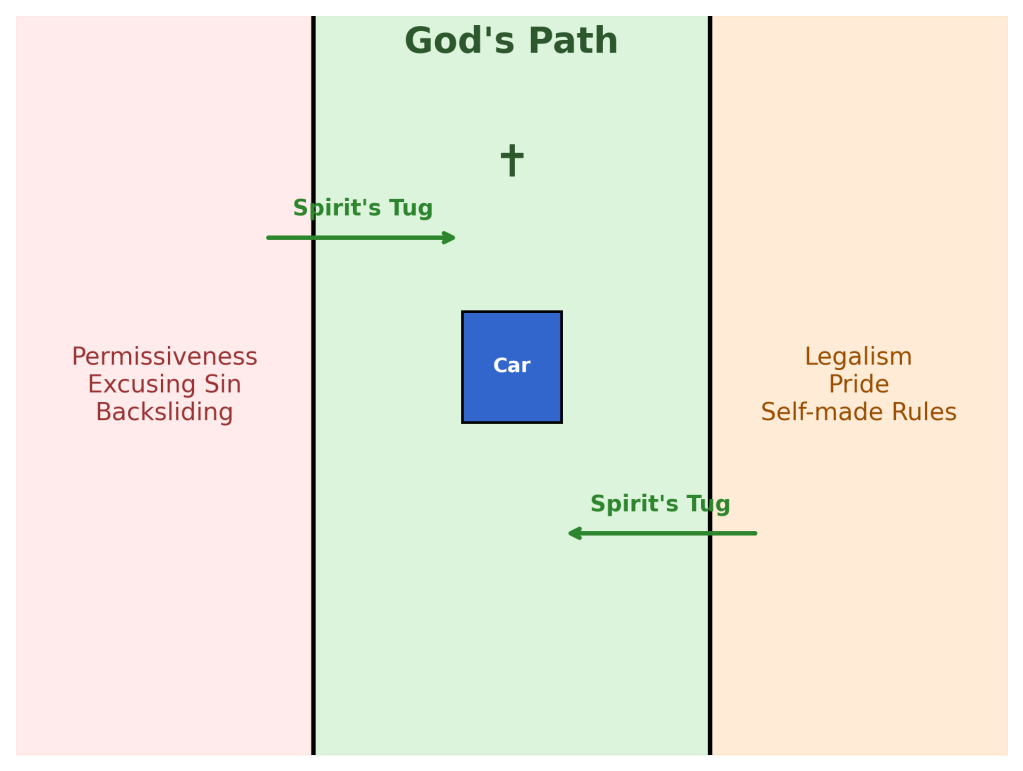
Steering Assist for the Soul

The Holy Spirit never forces us —yet, through gentle correction, can keep us from drifting into legalism or permissiveness.

We recently purchased a car with Steering Assist for the first time. At first, it felt odd: whenever I strayed from the center of the lane, the wheel would gently pull me back. My instinct was to resist, but I soon understood this feature was for my good. That same gentle guidance is a helpful image of the Holy Spirit’s work in our lives.

Scripture warns us not to turn either to the right or the left. God told His people:

“So be careful to do what the Lord your God has commanded you; do not turn aside to the right or to the left.”
—Deuteronomy 5:32

The way of obedience is straight, but our hearts are prone to wander. Drifting to the right can mean adding rules and traditions that God never asked for—the arrow in the diagram below shows the Holy Spirit gently nudging us back to center.

Drifting to the left can mean ignoring God’s commands or excusing sin, and again, the Spirit pulls us back to the right path.

I have felt these tugs more than once. Sometimes I become overly strict—like trying to track every calorie or gram of sugar. Eventually, I get frustrated and swing to the other extreme of overindulgence. Neither end is healthy. Food is just one example, but the principle applies to the Christian life as a whole: on one side, rigid legalism; on the other, careless permissiveness.

When I drift toward legalism, I sense the Spirit reminding me, “You’re burdening yourself with rules I never gave you.” Another danger is pride: holding others to my own standards leads me to look down on them. The Spirit gently corrects, “Return to the center. Judge less. Walk humbly.”

When I drift into permissiveness, the Spirit warns, “You’re returning to the very sinful ways you once left behind. Repent, and return to your first love.”

The Spirit’s prompts can be resisted, but wisdom tells us to yield. Ignoring these nudges only leads us further from God’s will.

Today, some automakers are developing cars with full automation, claiming they don’t need any driver input.

But after fifty years of following Christ, I know the Christian journey is never on autopilot. We always need the Spirit’s guidance—without it, we risk ending up in a ditch.

The lesson: remain sensitive to the Spirit’s promptings. Ask God daily to keep your heart responsive—through prayer, his Word, and fellowship with other believers. When He tugs your heart, don’t resist. Allow Him to realign you with His will.

God and Sinners Reconciled

Our new friend, learning of  my wife’s love for photographing swans, told us about a lake not far from us. She said the lake has a small fleet of swan-shaped paddle boats you can rent — a cute touch.

So we took up her suggestion. Unfortunately, that day the swans  let us know they were on vacation so we could not ride them. 

Instead, we hiked around the lake and admired the beautifully designed park landscape. Later I learned the park was the work of the Olmsted brothers, sons of the man who designed New York City’s Central Park. This park, a hidden gem, reminded us of High Park in Toronto.

At the start of our walk, my wife wore her Derek Jeter Yankees cap, and I wore my Mets cap. A couple stopped us and jokingly asked whether that difference caused conflict at home. We laughed and said, “No, we’re not fighting about baseball.”

But it made me think: what about when disputes are more serious?

Since the park is in Verona, NJ, my mind jumped to another Verona — the one in Italy where Shakespeare set his tragedy Romeo and Juliet. The Montagues and the Capulets were locked in a bitter feud. In the end, they were reconciled — but only after the senseless deaths of their children.

Can there be reconciliation without senseless death?

Our pastor has been preaching through Ephesians, and one message was titled “I Am Reconciled.” In Ephesians 2:11–22, Paul explains how Jews and Gentiles — once divided and hostile — are reconciled to each other and to God through Christ.

“For He Himself is our peace, who has made us both one and has broken down in His flesh the dividing wall of hostility… that He might reconcile us both to God in one body through the cross, thereby killing the hostility.” (Ephesians 2:14, 16)

Here again, peace comes through death — but not a meaningless one. Christ’s death was purposeful, decreed by God, and accomplished something astounding:

  • Hostility between God and humanity was ended.
  • Hostility between divided people can be healed.
  • A “new humanity” was created in Him.

This is not instant magic. It’s a starting point we must live out, sometimes with fear and trembling. In churches, in families, in communities — whether the conflict is over silly preferences or serious offenses — the cross is the only solid foundation for lasting reconciliation.

At the lake, my wife and I could wear different caps and still walk in harmony. In Romeo and Juliet, reconciliation came too late, purchased at too high a price. But in the gospel, the price of Christ’s  death was high – but it bought a peace that can last forever — God and sinners reconciled.

In Romans 5:10 we read:

“For if, while we were God’s enemies, we were reconciled to Him through the death of His Son, how much more, having been reconciled, shall we be saved through His life!”

Would you be willing to admit that you and God once stood on opposite sides — enemies because of sin — but now, through Christ, can be friends?
The first step is acknowledging that without Jesus, you would remain God’s enemy. Then, by admitting your need for forgiveness and believing that Jesus’ death fully accomplished that forgiveness, your life can do a 180.

Now you can enjoy the greatest reconciliation in the entire universe — peace with God Himself.