A strange little Halloween memory from the Nixon years — one that still makes me wonder about protection and providence.
This really happened one Halloween night during Richard Nixon’s presidency. I was walking along George Street near the river dorms at Rutgers when a car slowed beside me. The window rolled down — and a man in a hideous Richard Nixon mask leaned out. He threw an egg at me.
It hit me squarely… but bounced off harmlessly and splattered on the ground. For a second I just stood there, startled — then I laughed out loud. Was it just college mischief? Or one of those quiet moments that remind you you’re not as unprotected as you think?
A journey from childhood terror to understanding God’s refining love.
When I was nine or ten years old, the scariest flames I ever saw weren’t in a fireplace or campfire—they were the flare stacks of the Bayway Refinery. As my family drove the New Jersey Turnpike north from the shore, I would look out the window and see those flare stacks lighting up the sky. To my young eyes, they looked like explosions waiting to happen. I imagined they would erupt at any moment and consume us in fire. The adults said not to worry, but I couldn’t shake the fear. Little did I know then that those very flames, which seemed so dangerous, were protecting us.
Years later, I learned what those flares were. They weren’t explosions waiting to happen. They were safety systems—a controlled way to burn off excess gases that couldn’t be processed. The flames that once terrified me were protecting me. They prevented uncontrolled danger by burning off what didn’t belong.
That realization has often made me think about how the Bible describes fire. Scripture speaks of it in two vastly different ways.
The Consuming Fire
On one hand, there is the consuming fire of God’s judgment. Hebrews 12:29 declares, “Our God is a consuming fire.” This fire speaks of His holiness poured out against sin and rebellion. It is not safe, and it should not be dismissed lightly. For those who persist in rejecting Him, this fire is real and terrifying.
The Refining Fire
On the other hand, there is the refining fire. Malachi 3:2–3 paints the picture of God as a refiner and purifier of silver, carefully watching over the process until the dross is burned away and the precious metal remains pure. Unlike the consuming fire, this fire does not destroy—it cleanses. Like the refinery flares that safely burn off impurities, God’s refining fire works to burn away what doesn’t belong in our lives. It feels uncomfortable, even painful, but its purpose is good.
From Childhood Fear to Adult Faith
As a child, I only saw danger in those refinery flames. What I didn’t realize was that they were safeguards. In the same way, I didn’t yet understand that God would one day invite me into a life of trust in Jesus—the One who rescues us from the consuming fire of judgment and welcomes us into the refining fire of grace.
Following Jesus doesn’t mean instant health, wealth, or ease. Sometimes it means discipline, pruning, and refining. But for those who belong to Him, even the hard seasons are not punishment. They are part of His loving preparation.
My Own Refining Fire
I assumed I’d never stop running competitively as I got older. Sure, I’d slow down with age, but it would be a gradual change. But then I developed permanent atrial fibrillation. My running ability dropped almost overnight. At first, it felt like a serious loss.
Yet, in hindsight, I can see God’s hand in it. The fibrillation diagnosis became refining fire. It has slowed me down physically but moved me closer to God spiritually. And it gave me the opportunity to actively serve on the Board of my church. It stripped away some illusions of self-sufficiency and reminded me that my identity is not built on performance but on belonging to Christ. What I thought was destructive has, in fact, been a tool for my growth in faith.
The Fire That Saves
Today, when I see refinery flames lighting up the sky, I no longer feel the childhood terror I once did. Instead, I see a living reminder: there is a fire that consumes, and there is a fire that refines. The first warns me of the seriousness of sin. The second reassures me that God is at work in my life.
Through Jesus Christ, I know the difference. He endured the consuming fire of judgment on the cross so that I might walk through the refining fire of holiness and come out purified. What once terrified me has become a picture of grace.
This is necessary so that your faith may be found genuine. (Your faith is more valuable than gold, which will be destroyed even though it is itself tested by fire.) Your genuine faith will result in praise, glory, and honor for you when Jesus Christ is revealed. (1 Peter 1:7)
The Holy Spirit never forces us —yet, through gentle correction, can keep us from drifting into legalism or permissiveness.
We recently purchased a car with Steering Assist for the first time. At first, it felt odd: whenever I strayed from the center of the lane, the wheel would gently pull me back. My instinct was to resist, but I soon understood this feature was for my good. That same gentle guidance is a helpful image of the Holy Spirit’s work in our lives.
Scripture warns us not to turn either to the right or the left. God told His people:
“So be careful to do what the Lord your God has commanded you; do not turn aside to the right or to the left.” —Deuteronomy 5:32
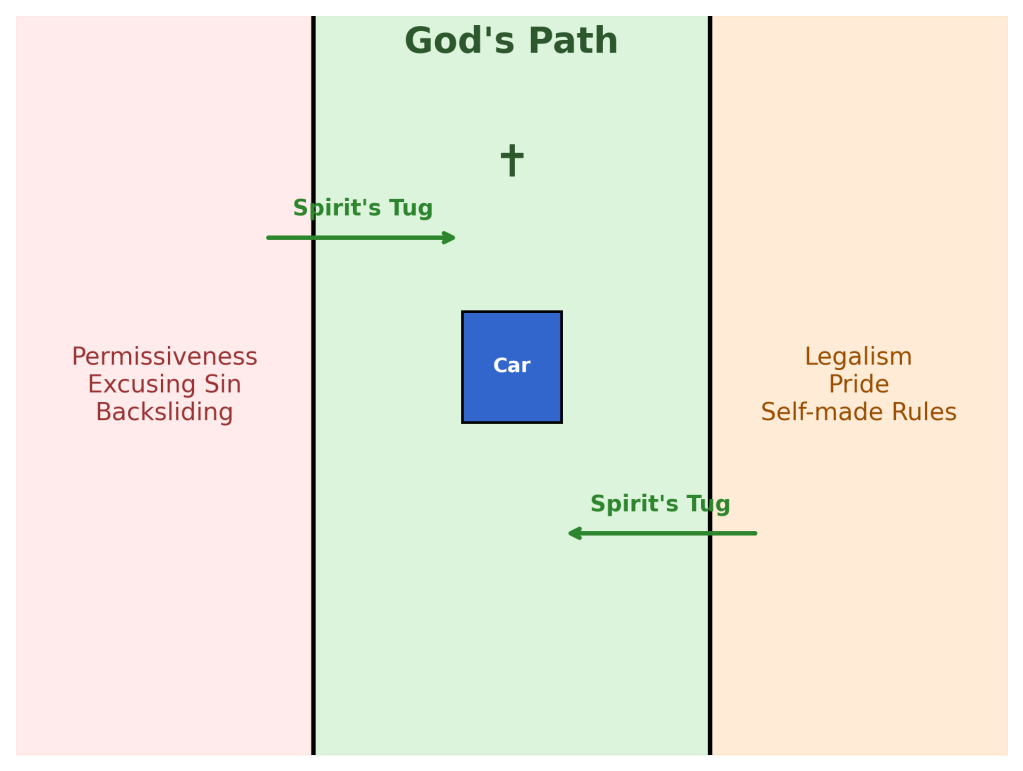
The way of obedience is straight, but our hearts are prone to wander. Drifting to the right can mean adding rules and traditions that God never asked for—the arrow in the diagram below shows the Holy Spirit gently nudging us back to center.
Drifting to the left can mean ignoring God’s commands or excusing sin, and again, the Spirit pulls us back to the right path.
I have felt these tugs more than once. Sometimes I become overly strict—like trying to track every calorie or gram of sugar. Eventually, I get frustrated and swing to the other extreme of overindulgence. Neither end is healthy. Food is just one example, but the principle applies to the Christian life as a whole: on one side, rigid legalism; on the other, careless permissiveness.
When I drift toward legalism, I sense the Spirit reminding me, “You’re burdening yourself with rules I never gave you.” Another danger is pride: holding others to my own standards leads me to look down on them. The Spirit gently corrects, “Return to the center. Judge less. Walk humbly.”
When I drift into permissiveness, the Spirit warns, “You’re returning to the very sinful ways you once left behind. Repent, and return to your first love.”
The Spirit’s prompts can be resisted, but wisdom tells us to yield. Ignoring these nudges only leads us further from God’s will.
Today, some automakers are developing cars with full automation, claiming they don’t need any driver input.
But after fifty years of following Christ, I know the Christian journey is never on autopilot. We always need the Spirit’s guidance—without it, we risk ending up in a ditch.
The lesson: remain sensitive to the Spirit’s promptings. Ask God daily to keep your heart responsive—through prayer, his Word, and fellowship with other believers. When He tugs your heart, don’t resist. Allow Him to realign you with His will.
Ecclesiastes 4:9-10 (NIV): “Two are better than one, because they have a good return for their labor: If either of them falls down, one can help the other up. But pity anyone who falls and has no one to help them up”.
I’ve never been what you’d call a daring mountaineer, but if you pointed me toward a half a mile long trail with a 10 percent grade, I could usually scramble up the rocks and roots to the top like a mountain goat. At least, I used to.
What a change it was on a recent hike. It happened at Camp Shiloh in West Milford, NJ, where I joined a bunch of guys from my men’s group for a hilltop climb. The trail itself wasn’t Everest—but soon into the ascent, I realized my nimbleness over rocks and brambles had sharply decreased.
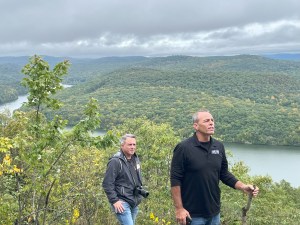
This is the mountain. These two guys are far ahead of Fred and me
I needed a helping hand. More specifically, I needed Fred—a man whose background is quite different from mine—to literally grab my arm before I took an unplanned tumble onto the rocks. In Christ, our differences are minimized; out there on the hillside, they vanished altogether in the urgency of keeping me upright.
This wasn’t easy to admit. I’ve always liked to manage things on my own whenever possible. But that morning forced me to face reality: even a trail that once felt easy can become a challenge over time. Once upon a time, I could run a decent marathon or tackle a ten‑mile race without a second thought. Watching my running prowess fade has been, in a word, disappointing—but I’m thankful I never built my entire identity around being competitive in road races.
The hike, surprisingly, became a living lesson in grace. I was reminded of the old song, “He ain’t heavy, he’s my brother.” That captures part of what I experienced—but not the whole story. Because it wasn’t just about man‑to‑man fellowship: behind Fred’s steady hand, I could see the quiet help of Christ and the Holy Spirit. That’s grace at work—helping us through decline, weakness, and stubborn independence.
So yes, my days of leaping over rocks like a mountain goat may be over—but how wonderful it is to grow in a grace that surpasses physical prowess and agility. We like to give brotherly hugs in our group – and now a hug with Fred reminds me of the care of one brother who prevented another from tumbling down a mountain.


 Kenny B's World