Category: The Christian Life

This I Believe (The Creed)

We sang “This I Believe” in our men’s group. The song is based on the Apostle’s Creed and the linked version is from Hillsong.1

Both the Apostles’ creed and “This I Believe say I believe many times.

Is that just a list of facts to believe? You may have heard the statements in the Apostle’s Creed as cold intellectual truths. I know I used to. But there’s quite a difference between assenting to cold facts and saying “Yes!” to a truth that our life depends on.

If someone says, “Atlantic City is the capital of New Jersey,” not much is at stake in whether that is true or not. 2 But what if I were driving a fully loaded 18-wheeler towards an old one lane bridge across a deep gorge. Can it support me and my load? To go across that bridge is to trust it with my life.

That second kind of belief, trusting with our lives, is the kind of belief sung about in “This I Believe.” Full-bodied genuine Christian belief is much deeper than simply saying “Yes” to some facts, and “This I Believe” takes what might only remain as head knowledge and transforms it into wonderful warm praise.

How do we get that kind of heartfelt belief? In certain circles you are ordered to believe each point in the Apostle’s Creed … or else. You must persuade yourself to believe and confess each of the points or you are in trouble.

But that attempt at self-persuasion is futile because we can only truly grasp these truths by faith. And that faith is itself a gift from God. In Ephesians 2:8-9 it says For it is by grace you have been saved, through faith—and this is not from yourselves, it is the gift of God— not by works, so that no one can boast.

We have been rescued from sin and death by faith in what Jesus accomplished in being crucified on the cross for our sin and then brought back to life. And as we follow Christ today, we continue by faith. By faith, we trust our lives to the God who gave us the creed’s truths:

I believe in God our Father. I believe in Christ the Son. I believe in the Holy Spirit. I believe in the resurrection, that we will rise again. I believe Jesus rose again. I believe that Jesus Christ is Lord.

The preceding truths all focus on our personal relationship with God in three persons, Father, Son and Holy Spirit. But now consider these truths:

I believe in the saint’s communion and in your holy church.

Here, we have union with Christ —– we join the faith and life of everyone who has ever loved Jesus —- in the unity of the Holy Spirit. God is invisible and we demonstrate our belief in this unseen God by loving real life people. Real life people whose flaws start to disgust us — until we look in the mirror! 

That’s when the great theological truths of the apostles’ creed stop being only abstract and cerebral. God is the God who changes us. The creed comes alive as we live out the Lord’s command to Be kind to one another, tenderhearted, forgiving one another, as God in Christ forgave you. (Ephesians 4:32.)


  1. https://www.youtube.com/watch?v=GDeA-SAlklU
  2. Atlantic City is not the capital, Trenton is

 

Weird or Welcoming?

 For John came neither eating nor drinking, and they say, ‘He has a demon.’ The Son of Man came eating and drinking, and they say, ‘Here is a glutton and a drunkard, a friend of tax collectors and sinners.’ But wisdom is proved right by her deeds.” (Matthew 11:18-19)

Are we feasters or fasters?

John is John the Baptist. He exercised a strict self-control and people mocked him. And Jesus (the Son of Man) enjoyed a good party and was falsely accused of being a drunk who liked to pig out.

In what ways are today’s Christians like John the Baptist? There are several ways we seem to be weird and strict in today’s culture. First, as we rely on guidelines from the Bible, we’re falsely accused of being puritanical, tyrannical, and narrow-minded.

Another way we seem a little weird…. who ever heard of fasting nowadays? (Especially when it’s not even part of a health food craze!) One day a bunch of us were fasting because we wanted to pray for God’s blessing on the church as we entered the fall activities for 2021.

And finally, we have a cross in our church sanctuary. Yes, it is weird to rely on the sacrifice of a Jewish carpenter on a cross two thousand years ago. But life today too often leads to people being angry, depressed, alienated and lonely. The weirdness of the cross propels us into a love that ends up in feasting.

This Christmas week our church1 had our second outdoor Christmas Village with joyous music and delicious goodies…. as representatives of Jesus, we were joyfully eating the best German bratwurst, drinking hot cider, and crunching fresh-made kettle corn. We welcomed anyone from town who wanted to join in. So, in answer to today’s title question: Both these things are true — we are both weird and welcoming!

  1. https://www.thechapel.org

You’ll get a beautiful bride if you capture that city!

In the book of Joshua, Caleb promised to give his daughter Achsah in marriage to whomever captured Kiriath-sepher. Othniel led Israel to that victory and married Achsah.

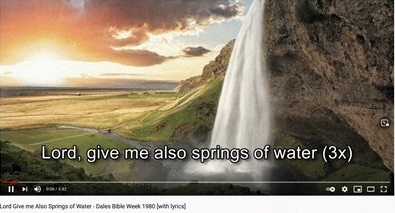
Pressed by Achsah, her new husband requested and gained a field from her father. Achsah then went even further when she saw her father and asked “Give me a blessing. Since you have given me the land of the Negeb, give me also springs of water.” And he gave her the upper springs and the lower springs. (Joshua 15:19) And that’s the inspiration for today’s song.

The prosperity gospel says you can speak something good into existence by naming it and claiming it, thereby cashing in on guaranteed material prosperity. That’s bogus and I avoid it. But because of my steering clear of that, I risk going to the other extreme and not asking for what God really does have for me. Sometimes it is OK to ask for, and receive, more material blessing!

“Springs of Water” includes material blessings for us but then it goes far beyond that:

O Lord, together let us overflow,
We see the harvest field shining in the sun.
Lord, let the river overflow,

We see how the blessing of God’s grace has spread beyond the original promised land in the Middle East to a worldwide outpouring!

Postscripts

This song’s content leads to a couple of observations on what makes a good worship song. First, it’s hard to go wrong when you put Scripture to song. You are singing timeless truths!

A good worship song has biblical imagery even when the lyrics are not quoting bible verses. Take “overflow” from today’s song. The song is not quoting a verse here, but you can indeed find the idea of overflow quite often in Scripture. For example, anyone who is growing in Jesus is
“rooted and built up in him, strengthened in the faith as you were taught, and overflowing with thankfulness.” Colossians 2:7. 

The content of todays’ song contrasts nicely with the bizarre imagery often found in contemporary worship songs. It’s often so different from what’s in the Bible that it makes you scratch your head. Here’s a parody of this kind of imagery, where the worship song even includes avocados! https://www.youtube.com/watch?v=cst1YYQZwsM

We first sang today’s “Springs of Water” song decades ago and it still brings tears of joy. Today’s video was sung in the United Kingdom in 1985 and the song was popular in the charismatic renewal on this side of the Atlantic, too. The link to view it is:

https://www.youtube.com/watch?v=6NCNlJorNME

Finally, as a bonus, you can find a good devotion with another slant on Achsah on the website my wife and her friend keep, Dig Deeper Devotions.

https://www.digdeeperdevotions.com/2021/04/22/acsah/

Why refuse mercy?

We love singing about God’s mercy and love. But not everybody dwells in God’s mercy. Is God depriving them of something? Does he have a mean streak?

To answer that, first consider this question:  If someone sincerely cries out “Lord, have mercy” would God ever say no?

Never, because “Mercy triumphs over judgment” (James 2:13b)

But what if someone says, “God, I don’t need your mercy”? And they repeatedly say “No.” Will they receive mercy? No, God lets them stay where they are.

Here’s a friendly warning:

Don’t have a hard heart! To see this at work consider the book of Exodus. Pharoah was warned to let the Israelite people to go. But Pharoah said no and God sent a plague each time Pharoah disregarded the warning. Each plague was worse than the one before it, but Pharoah still did not listen. With each plague he got more stubborn and hardened.

The same thing happens today when people say no. The more they say no the more they become hardened.

King David wrote the following after plotting the death of the husband of a woman he had slept with. David deserved the death penalty for that. Yet, forgiveness was available! Mercy is what we receive instead of the wrath that we deserve.

 Have mercy on me, O God,
    according to your unfailing love;
according to your great compassion
    blot out my transgressions.
 Wash away all my iniquity
    and cleanse me from my sin.
(Psalm 51:1-2)

King David’s plea gave a sneak preview of what was fulfilled later in the arrival of King Jesus.

 But when the kindness and love of God our Savior appeared, he saved us, not because of righteous things we had done, but because of his mercy. He saved us through the washing of rebirth and renewal by the Holy Spirit, whom he poured out on us generously through Jesus Christ our Savior (Titus 3:4-6)

Here is my cordial plea: Please don’t be like the Pharoah. He did not ask for mercy and it did not work out very well for him. Do you want mercy? Just ask for it in the name of Jesus Christ.