
Category: Devotions

What does it really mean to have more of Jesus?

ball pub

 For in Christ all the fullness of the Deity lives in bodily form, and in Christ you have been brought to fullness. He is the head over every power and authority. (Colossians 2:9-10)

Does having more of Jesus mean getting all pumped up emotionally? That easily happens when we go to a retreat, mission trip, etc. Our balloon is soaring higher and higher.   But then —– we return home.

I remember one time driving to work the day after a 3-day retreat and someone did not think I was driving up the entry ramp to the Interstate fast enough. So, they gave me a long blast on their horn! Yes, after our return, somehow the realities and stresses of everyday life have not changed…soon we are swamped by them again and then we become like that picture of the deflated balloon.

How, then, can we have a more robust view of more of Jesus?

I think we need an encounter with our God of fire and holiness.

Therefore, since we are receiving a kingdom that cannot be shaken, let us be thankful, and so worship God acceptably with reverence and awe, for our “God is a consuming fire.” (Hebrews 12:28-29)

Our God is a consuming fire. Should we be terrified about this? Am I throwing fire and brimstone at you?

Let’s look at what the Prophet Isaiah said after a frightening encounter with God.

 “Woe to me!” I cried. “I am ruined! For I am a man of unclean lips, and I live among a people of unclean lips, and my eyes have seen the King, the Lord Almighty.” (Isaiah 6:5) 

Does this experience make Isaiah pull back in fear or give up? No, he next learns that God forgives him. And then see what happens next in verse 8:

Then I heard the voice of the Lord saying, “Whom shall I send? And who will go for us?”   And I said, “Here am I. Send me!” 

What if we too start at a place of “woe is me” and then become able to say, “forgive and cleanse me Jesus” and then “I want more of what you want?”

Then, we are empowered to be used and sent. As I often have said in my blog posts, this does not mean we must be doing wonderful and spectacular things for the Lord. The sending can be to tasks that appear to be ordinary.

These ordinary tasks begin to change what we want, care for, think we need, get annoyed at, etc.

So, even when the realities and stresses of everyday life have not changed, Christ is changing our way of reacting to them.  It’s these little changes that add up over time to a changed, maturing character that really does have more of Jesus.

Three Times

Rooster Crowing cropped

Then Jesus answered, “Will you really lay down your life for me? Very truly I tell you, before the rooster crows, you will disown me three times! (John 13:38)

You’re probably familiar with the story of Peter denying Jesus three times and then the rooster crows. And probably you have heard that that is because Peter had not yet received the Holy Spirit to make him courageous and bold. And that, since we do have the Holy Spirit now, that means we rarely, if ever, betray Jesus or sin against him. Right?

Not really! Even now, when I walk in victory, I overestimate how well I can lay down my life to follow Jesus. I start to think of the ways I will never sin again. Unfortunately, in a sense it is inevitable that I sin today. That does not mean I plan to! But rather, in some way, I will miss all of God’s best for me today.

There are two extremes which are so easy to fall into. One is patting myself on the back for not sinning and walking in such victory. And the other extreme is feeling all beat up when I do sin.

 My dear children, I write this to you so that you will not sin. But if anybody does sin, we have an advocate with the Father—Jesus Christ, the Righteous One.  He is the atoning sacrifice for our sins, and not only for ours but also for the sins of the whole world. (1 John 2:1-2)

At first glance, these verses look like a contradiction. But not really. “Will not sin” refers to our old lifestyle before we knew Jesus where we sinned continually and never felt the need to repent.  That is over with. We are free from that.

But that does not mean we never sin. So, happily, when I do sin I have an advocate: the Lord Jesus.

Keep in mind that our freedom from sin is a process. The key is to know that we are on the pilgrim’s path. Then we can avoid bouncing between the extremes of either being puffed up with overconfidence or wallowing in the muck of despondency and defeat.

Lord, we thank you that you grow us as we persevere in following you.

Calmed and Quieted

  I do not concern myself with great matters
     or things too wonderful for me.
  But I have calmed and quieted myself,
     I am like a weaned child with its mother;
     like a weaned child I am content. (Psalm 131:1b-2)

I have recently read some heated arguments amongst Christians about Genesis versus Science.

One book I recently read gave me a spiritual headache. It claimed to have found “the” answer to the connection between Adam, Genesis, and science. Why did it give me a headache? Because the authors insisted that they had found the right answer at last… and that perhaps anyone who did not see it their exact way was just a little bit ignorant.

But here’s a thought about the right answer.

If God wanted Genesis to provide a detailed science textbook explaining how exactly he did what he did, couldn’t he have provided it? Does he owe us an explanation of how he did what he did? That brings to mind God’s challenge to Job:

“Where were you when I laid the earth’s foundation?
     Tell me, if you understand.
  Who marked off its dimensions? Surely you know!
     Who stretched a measuring line across it? (Job 34:4-5)

Here’s what I see as indisputable about the creation account in Genesis:

What God did: He created.

Why God did it: To show his glory and call a people to himself through his Son Jesus.

Isn’t it refreshing to just rest in awe of what God did and not worry about how He did it?

That’s why today I will not attempt to give you a final explanation of how science and Genesis are connected.

I will simply accept that some of this is just beyond me, but still very wonderful. And that leads to the result in the second verse of today’s Psalm: contentment.

I experienced the Psalmist’s path to contentment in recent prayer times as I prayed through different issues. This peace is a gift from the Spirit that we all receive if we ask. When we “let” God keep his secrets, and trust that he does tell us what we need to know, then – what a wonderful result: we truly become more calmed, quieted and content.

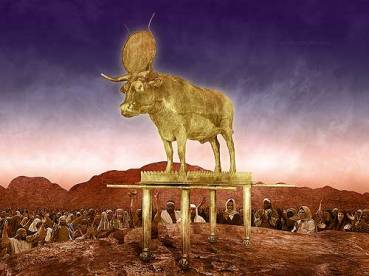
I wouldn’t build a golden calf..or would I?

the-golden-calf-idol

“You came down on Mount Sinai; you spoke to them from heaven. You gave them regulations and laws that are just and right, and decrees and commands that are good. (Nehemiah 9:13)

What does it mean to keep the commands? Should we even care?

As New Testament Christians, since we are in an age of grace in Jesus, it is easy to look at the Old Testament and say oh, it’s just a bunch of legalistic rules and regulations. I don’t have to worry about obeying.

But in today’s passage Nehemiah is giving his people a reminder of something that happened for them many centuries earlier. He reflects on who God is, and what God did, back in the times described in the book of Exodus. Obedience is connected to what God is really like: God is just, God is right, and God is good. Obedience gives us a taste of all three of these wonderful qualities of God.

But Nehemiah understands quite well that we do not automatically obey.

 “But they, our ancestors, became arrogant and stiff-necked, and they did not obey your commands. (Nehemiah 9:16)

They deserved to be left alone by God. But, amazingly, we hear,

…… But you are a forgiving God, gracious and compassionate, slow to anger and abounding in love. Therefore you did not desert them, even when they cast for themselves an image of a calf and said, ‘This is your god, who brought you up out of Egypt,’ or when they committed awful blasphemies. Because of your great compassion you did not abandon them in the wilderness (Nehemiah 9:17b-19,emphasis mine)

But, what if we rebel and make an image of a golden calf and worship it?  As modern 21st century people we say “Who, me?  I wouldn’t make a calf. I’m not like those primitive people.”

But think about this: Jesus says, “He who loves me…keeps my commands.” Doesn’t the calf stand for anything we treasure more than keeping Christ’s commands? Aren’t we worshiping that thing more than Christ?

Nehemiah gives us a wonderful preview of God’s forgiveness for us in Christ.  Because of God’s great compassion he does not abandon us in the wilderness even when we make an idol; instead he sent Christ to rescue us.

Through Christ giving us the Spirit, we can reflect God’s justice, righteousness, goodness—-and love. And because God’s love outweighs his anger, Christ always keeps the door of repentance open.

Father, we thank you that you do provide rescue for us in the person of Jesus, that because of your great compassion you do not abandon us.